Yangha Career: Part of the pride of EBOMAF's works
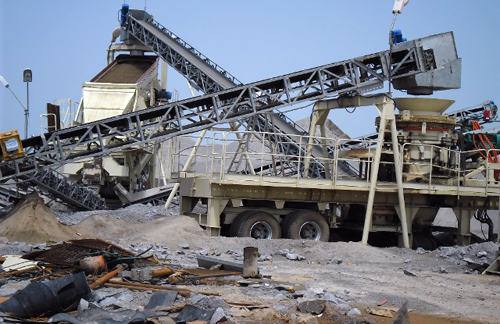
A few blocks from Kombissiri, capital of the Bazèga province, in the rural commune of Doulougou, Yangha's career bears the proud imprint of the EBOMAF Group. It is from this village that most construction sites are supplied with aggregates (gravier, gravel). With very modern facilities on site to crush the rock and an important park of trucks for transport, this is another challenge that is won every day to the delight of the works scattered throughout the territory and even outside the borders.
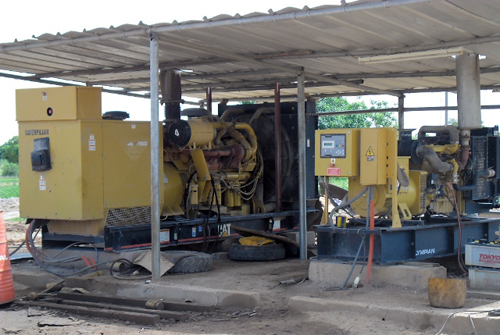 The exploitation of Yangha's quarry benefits from an energy autonomy provided by this large generator[/caption]
No serious company can excel in the Building and Public Works (BTP) sector if it does not have a career in its name. This prerequisite is, moreover, decisive for its ambitions and its foundations. Aware of his vision as a leader, EBOMAS did not hesitate to offer one in the village of Yangha, in the rural commune of Doulougou, about twenty kilometers from Kombissiri, capital of the province of Bazèga. As an open-pit mine in the middle of the rocks, with state-of-the-art installations demonstrating the impact force of the company on which it depends, Yangha's career plays a key role in EBOMAF's road markets. Five kilometers from National Road 5, just before reaching Kombissiri, the company EBOMAF has set up its bases for the exploitation of a vast field of rocks. The calm in this month of August is just a temporary stoppage of work observed by society. Although impressive, bulldozers and other large earth-moving equipment are certainly silent, for a well deserved rest, after well-serviced but their presence bears witness to the importance of this site.
A few guards guard the premises to keep the installations, equipment and equipment in perfect safety while waiting for a very soon resumption of activities. Opened in March 2010, Yangha's career employs about 30 people, half of whom are from the village, as is customary for CEO Mahamadou Bonkoungou to promote local labour in the execution of its construction projects.
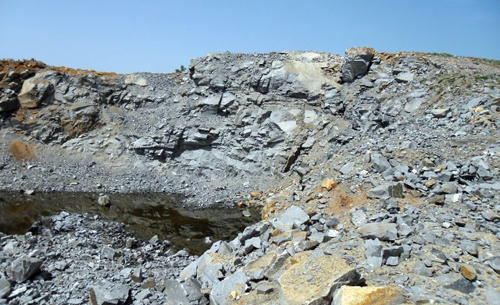 The construction manager, Geovanni being absent, the site visit is conducted under the guidance of a career employee. The extraction of the rocks and their crushing is done at the chain. It consists of extracting large blocks of stone after blasting the granite hill. The stones are then inserted into a machine to be crushed in order to get smaller pieces. They are transported to undergo a second operation, that of a transformation again. They are introduced into the mill using carpets to be reduced according to the desired size, gravel or gravel. Gravel and gravel mounds stored at the site reflect the immensity of work at the quarry. Until the stop in July 2011, it operated on a daily basis, allowing a daily ballet of about 30 flanked dump trucks, EBOMAS, to transport gravel and gravel to the various construction sites in Ouagadougou, Dédougou and even Lomé in Togo.
The quarry occupies a central place in the company's equipment like the base in Kossodo, which houses, in addition to the car fleet and repair shops, the prefabricated concrete and clad concrete installations. It is from Yangha that the supply of construction works in aggregates is carried out. Even those of the Koudougou-Dédougou road come from there because the classified forests of Tissé in the West Centre and Tiogo in the Boucle Mouhoun, prevent any material removal.
[caption id="attachment 364" align="alignleft" width="500"]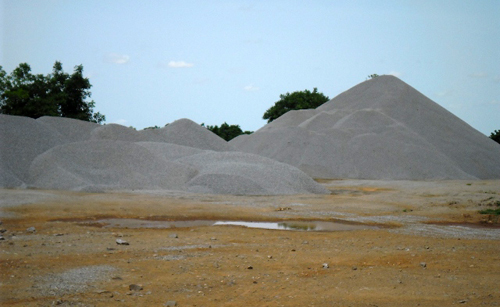 Gravel and gravel mounds obtained after stone block transformation[/caption]
Although in this month of August 2011, the activity on the site in Yangha is slowing down due to the maintenance issues of equipment, holidays and rainy season, the equipment arranged here and there as well as the large stock of granite convince work that is being slaughtered there. And this is how it is in all countries where EBOMAF is entrusted with work. It first puts in place substantial means to offer a modern and efficient career, guaranteeing all the good execution of the yards and the success of the works. Gravel is one of the essential materials used in the construction of roads, works of art and sanitation. "Leadership is based on a vision," says Mahamadou Bonkoungou, CEO.
Eugene PATOIN
Commentaires (0)
Laisser un commentaire
Vous devez être connecté pour commenter
Articles récents
A Field Mission of the Governor of the Estuary on Compensation for Affected Populations
Lire l'article →