Buildings and public works in Togo: EBOMAF attacks international
The Burkinabe company specializing in Building and Public Works (BTP), Bonkoungou Mahamadou & Fils Company (EBOMAF SA) is admirably conquering market shares outside national borders. Among other things, it was chosen to build the Dapaong-Ponio-Frontière section of Burkina Faso (Kompienga) on Togolese territory.
The official launch of the work on Wednesday, 1 September 2010 saw the presence of the highest authorities in that neighbouring country. After a dozen years of activities marked by unrivalled know-how, EBOMAF SA's reputation is thus recognized outside its home country.
After giving evidence of its expertise in building and public works (BTP) on several large-scale construction sites, including the development of the Zone d'activités commerciales et administratifs (ZACA) in Ouagadougou, the Bonkoungou Mahamadou & Fils Company (EBOMAF SA) has set up an ambition to position itself in the West African sub-region from the Togolese Republic.
Mahamadou Bonkoungou, President and Chief Executive Officer (DG), can now show at any point the professional smile and relief confirming internationally the viability and reliability of his company. "No one is a prophet at home. All kinds of gossip have been circulating on my company and its activities.
But today the good faith triumphs over dishonesty, which consists of wrongly vilifying those who dare and are committed to participating in the outbreak of expertise in a field dreaded and long controlled by multinationals. No country and its development partners in the world can entrust a company with their major works if they are not sure of the quality of the works that will be built," he justifies this fraught breakthrough outside national borders.
The choice of EBOMAF SA by the Togolese authorities for the development and construction of the Dapaong-Ponio-Frontière road in Burkina Faso (Kompienga) is for it the best and unanimous guarantee of know-how in such a delicate sector and demands that the BTPs. This brilliant conquest of the sub-regional market runs short of the supputations and rumors that the public limited company founded in 1998 with a capital of 300 million CFA francs by the young economic operator Burkinabé born in 1966 in Dédougou of commercial parents.
Following an open and fierce international tender by multinationals and other African bitumen sizes, EBOMAF SA was the one who, through its technical analysis and financial offer, convinced the very interesting procurement commission of the Ministry of Public Works. "Before being crowned outside this market, the human and technical skills of our company were sufficiently tested in Togo in the erection of major art works. The construction of bridges on important rivers and rivers according to the required time and standards has been a major factor in our favour.
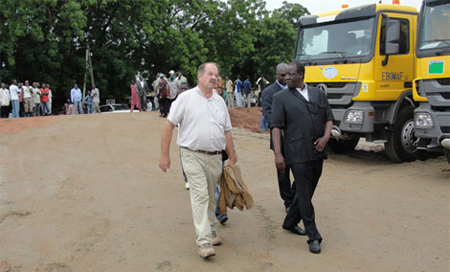
It is difficult to cheat in this sector both in one's own country and outside of the moment when the regulation of public procurement procedures is increasingly harmonised and standardized from one regional area to another," says Mahamadou Bonkoungou, CEO of EBOMAF SA. On the eve of the launch of the works of the section to which it entrusted, Tuesday 31 August, an emissary of the Togolese government in the person of the Minister of Public Works, Tchandja Andjo wanted to review the execution of these infrastructures-tests.
At the head of an important delegation composed of engineers, controllers, heads of mission and partners of his department, the first in charge of Infrastructures went back to the letter on the ground, the thread of the contracts between his country and EBOMAF SA. His suite was thus deported first to the crushing quarry where the sand is prepared for the enrobed and gravel, as well as on the building site at Dontoungou of a bridge with four beams forty (40) meters long and eight (8) meters wide of a height of four (4) meters.
Subsequently, the Togolese authorities sought to secure the force of the Burkina Faso expertise on the Dapaong-Mandouri section where Mahamadou Bonkoungou's company showed its great mastery of the major works, particularly on the Niyork river and admirably on the Tanloaga bridge, eighty (80) kilometres long and eight (8) metres wide where it was necessary to work 24 hours a day with projectors and about fifteen motor pumps.
The works of art in finishing according to international standards convinced each other on the guarantees of a good execution of the yards. "The existence and dynamism of sub-regional groupings, true frameworks of all-embracing policies for development and integration are to be welcomed as they have offered us the opportunity to submit our experience to the Togolese authorities," said Oumar Bonkoungou, Deputy Director General of EBOMAF SA.
The furrows of fame
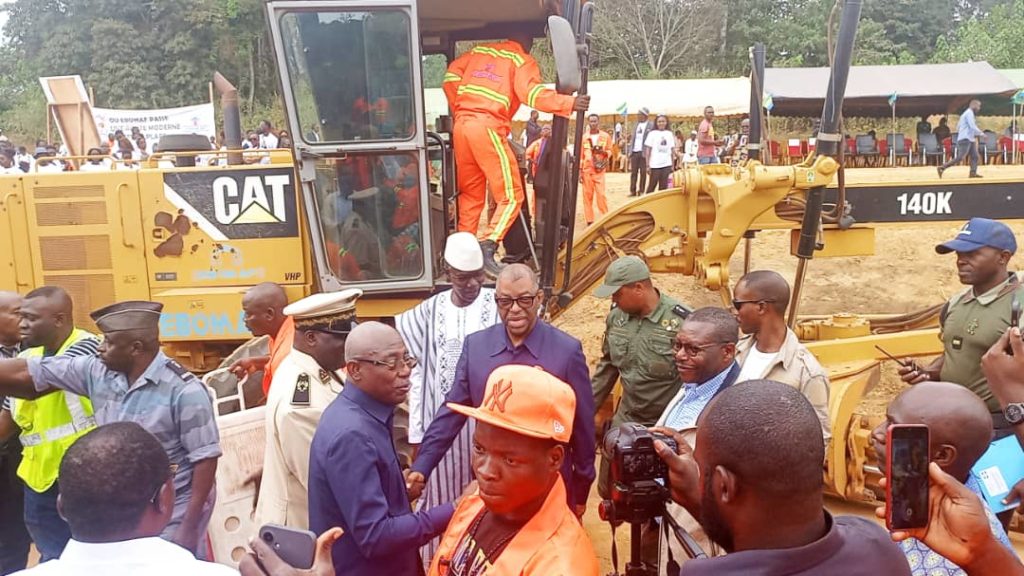
 The opening ceremony of the opening of the Togolese Savana region promised by President Faure Essozimna Gnassingbé, which took place on Wednesday 1 September 2010 in Dapaong, northern Togo, some 50 kilometres from the border with Burkina Faso, brought together several personalities including the Minister of Public Works and the Delegate for Agricultural Infrastructure.
They have come to express the importance of this path in national development and to translate their faith into the ability of an African sub-regional society or even a neighbouring country to carry out major quality work according to international standards, as it has demonstrated in its own Faso since its founding.
" In carrying out our work, the understanding and facilities of riparian populations and users will be of great benefit to us. Already, I know that we will be able to count on everyone's support for today's mobilisation," said DGA Oumar Bonkoungou. Beneficiary populations did not negotiate their support for the project: they came from many of the four prefectures (Tandjouaré, Loty, Tône, Kpendal) making up the Savanes region to sign up to the project and to acclaim its effective start.
"Every African concerned and optimistic about the future of his continent should draw legitimate pride from the achievements of EBOMAF SA. That the company is from Burkina Faso doesn't matter. Essentially, it is that it eloquently translates expertise into a sector whose Africa has long been brillianced by its incapacity. With the wind of integration so much desired by the Heads of State and the people, the know-how no longer has borders," said a senior official of the Togolese Ministry of Public Works.
The Dapaong-Ponio-Frontière section of Burkina Faso (Kompienga), whose layout and bitumening are devolved to the EBOMAF SA/Kara Establishment group over a distance of thirty-eight (38) kilometres. Financing is provided by the Islamic Development Bank (IDB), the West African Development Bank (WADB) and the Togolese State for CFAF 12.1 billion.
" Our Burkinabe compatriots must finally resolve to recognize that we are driven by the sole aim of participating in national development by mobilizing through our professionally maintained activities to mobilize resources both inside and outside for the benefit of our country's economy," said the great boss of EBOMAF SA.
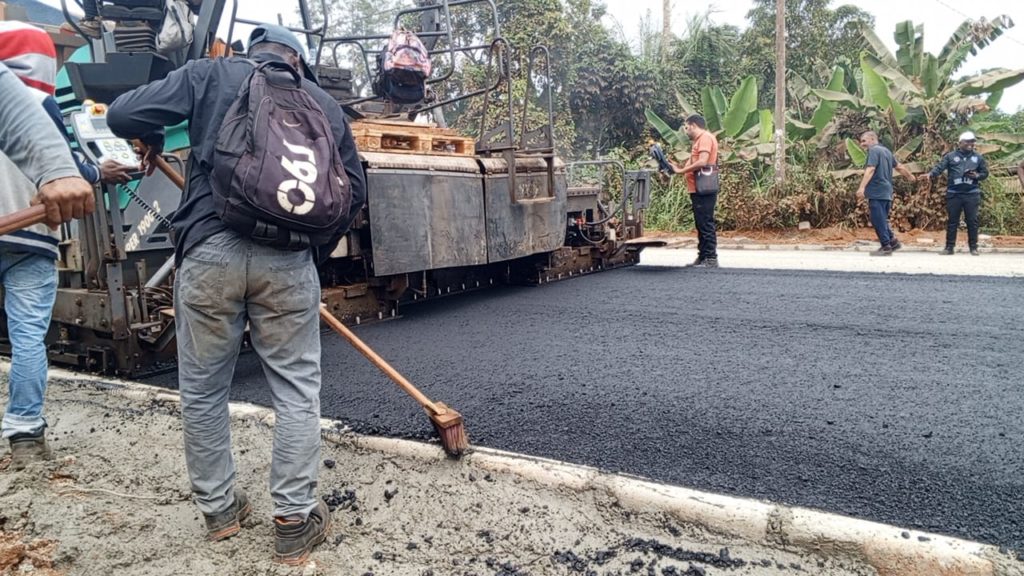
The work thus initiated consists of building a dense coated road covering several geometric variables (see Box). They are planned to last fourteen (14) months under the supervision of the CIRA & DECO IC offices and the supervision of the Directorate-General for Public Works.
This axis thus shortens traffic with eastern Burkina Faso and mainly with Niger. No need to go through Cinkansé and Bitou. Just bifurcate by Dapaong to easily reach Kompienga in 45 minutes, Fada NGourma in 1h30 and Niamey in three hours. The old axis opened in the 1960s is undergoing a sharp deterioration to the point of considerably restricting the mobility of people both within and outside the region.
" The beginning of this work is a promise made by the Togolese president when the Tône prefecture was in the waters in 2007 and its Bourgou bridge completely drowned. The crashes on this day of the machines of EBOMAF SA, an internationally recognized good faith company, are therefore the crowning of respect for the word given to the Head of State," recalled El Hadj Ali Mossiyamba, Prefect of Tône.
Togo has set itself the goal of de-enclaving its northern part. The next few weeks will see the start of work on the Tandjouaré-Cinkansé axis and on the Dapaong-Mandouri axis in early 2011. Other similar initiatives are scattered across the country. "These infrastructures demonstrate the firm will of President Gnassingbé to resolutely commit Togo to development by modernising the channels of communication to facilitate internal exchanges and those with the countries of the hinterland using our country's corridor," Minister Andjo said.
While reassuring his compatriots of the smooth running of the works, he simply hoped that in the performance of the tasks, EBOMAF SA would employ the young people of the locality so that the investments made would bring added value to the well-being of the people. "Our company is committed to scrupulously respecting the terms of the contract relating to this work as it has always kept to the letter on all its construction sites," reassures DGA, Omar Bonkoungou.
Taking advantage of the renewed interest in the construction industry in this neighbouring country, the Burkinabé company is relying on the realization of this major construction site in Togo to announce the beginnings of its internationalization. It is gradually positioned throughout the Togolese territory through major construction sites in real estate and roads in Lomé, Kara, Dapaong, etc. Its presence is also remarkable in the maintenance of runways and the construction of hydraulic structures.
The CEO, Mahamadou Bonkoungou does not squeeze on the means to meet the challenge and win honorably the bet of this outside conquest. "We need to know how to be efficient in any business development initiative. We are aware of the challenge by launching an attack on the sub-regional market. It is necessary for us to preserve our achievements at the level of Burkina Faso, but also to drive with serenity the construction sites open outside. To do this, efficiency remains the key word for not dispersing forces.
None of the equipment currently used in Togo comes from elsewhere. They were purchased and intended solely for work in that country. This option is the best way to avoid dispersing our forces and carrying out all construction projects," explains Mahamadou Bonkoungou, CEO of EBOMAF SA. Indeed, the construction of the Koudougou-Dédougou section of one hundred thirty (130) kilometres is entering its decisive phase as early as 15 September next with a mobilization of the same human, material and technical means.
At the head of a team made up of African engineers and technicians and expatriates who had broken into the trades of the BTP, he deployed effectively the wings of his future Togolese subsidiary. About 10 billion CFAF were devoted to the control of almost new state-of-the-art equipment: graders equipped with lasers, concrete mixers, crushers, toupies, bulldozers, tank trucks, foot- and grade cylinders, etc.
Until the very next installation on site of a coated power plant. The Togolese branch of EBOMAF SA already enjoys human, material and technical autonomy. It gradually surrounds a park of vehicles as impressive as that of the base located in Kossodo in Ouagadougou.
 Jolivet Emmaus, (Joliv et@yahoo.fr) Back from Dapaong (Togo)
Two questions to Tchandja Andjo, Togo's Minister of Public Works "The choice of EBOMAF SA is far from fanciful"
How does the first road infrastructure manager in Togo appreciate the choice of a Burkina Faso company to build such an essential and strategic road in your country?
Prior to the official launch of the Dapaong-Ponio-Frontière section of Burkina Faso, we had to visit technical installations and a number of infrastructures mainly works of art carried out by EBOMAF SA.
All in all, we conclude that this company is cutting off good and good work. The bridges visited in Dontoungou and on the Dapaong-Tanloaga axis received our complete satisfaction. The choice of a Burkina Faso company to carry out the development and construction of such an important road as the one linking Dapaong to the border of Burkina Faso is certainly a sign of sub-regional integration, but it should be remembered above all that this offer is far from fantasy.
Donors accompanying the Togolese state in financing this project, BOAD and IDB have procedures that are essential. Therefore, it was after an open international tender that EBOMAF SA was selected after providing the assurances and evidence of its competence.
We see no problem in the fact that the work is entrusted to this undertaking. The Department of Public Works for which we are responsible carried out its small investigation into this company and found that it had to execute a number of similar contracts contained in its offer and confirming its experience in this area.
Beyond this assessment, we welcome this infrastructure as it will further promote integration between Togo and the two countries, Burkina Faso and Niger, thanks to the improvement of this road. And the fact that it is a Burkina Faso company that runs it is just as comforting because Togo has excellent relations with that neighbouring country.
What is the impact of the development and construction of the Dapaong-Ponio-Frontière axis of Burkina Faso on the populations of the Savana region and on exchanges with neighbouring countries?
This section will open up northeastern Togo. The Tanloaga bridge will connect Ponio with its mother prefecture, Mandouri. This allows users in eastern Burkina Faso and the Niger to gain better access to this part of the country. The aim is to end the contour extending distances. It is an axis that therefore strongly integrates Togo, Burkina Faso and Niger. A regional portion whose economic importance is no longer to be demonstrated.
Interview conducted in Dapaong by Jolivet Emmaus
Eclats of joy and optimism among beneficiaries
El Hadj Ali Mossiyamba, Prefect of Tône, Savana Region:"The launch of this road infrastructure in the Savanes region is of paramount importance. The section to be bitumen passes through five cantons (Dapaong, Katindi, Touga, Korbongo and Louanga) in Tône Prefecture. These communities will now be connected more easily. The section will allow them to better communicate with Punjab Prefecture. This is a real reason for satisfaction. The only view of the material displayed here to start the work convinces of the good completion of the project".
El Hadj Issa Chede, Mayor of Dapaong, Head of the Savane Region:"This road infrastructure under construction is essential for the development of this part of Togo. It is a dream maintained by the people for five years. This day therefore marks the beginning of the realization of their wish.
They see their expectations fulfilled. The inhabitants of this area have many relatives on the other side of the border, especially in the Gulmu. But they are embarrassed in the relationships that they would like to maintain by the old way that limits the movement. Beyond the brotherly ties that will strengthen, it is sub-regional integration that enriches. Once developed, this path will improve and increase trade between Togo and the landlocked countries.
The difficulties on this path have for a long time hampered the desire to express the fraternity of the populations on both sides of the borders, while at the same time hindering the move towards development. This will therefore put an end to the harassment and further increase freedom of movement. By transforming in a single day under the eyes of the people a bottom to make it the pleasant site that hosted the start-up ceremony, EBOMAF SA was able to demonstrate from the outset its ability to deliver on its commitments".
Baminté Tambaté III, Chief of Canton of Nanergou, site of the quarry of the site:"As a customary head of the territorial community hosting EBOMAF SA's career, we hope that this company will build a good road for the happiness of Togolese and their Burkinabé neighbours as well as for the Nigerians. In addition to this concern, the Canton of Nanergou wishes the successful company to invest in social works by erecting a maternity because this locality does not have one.
It is an old demand of the inhabitants never satisfied by the successive companies for work in the area. So we dare to believe that EBOMAF SA will hear this cry from the people and help them. It will be a plus for the health centre. Long ago we heard of this company before it arrived here. Both its quality works and its social works are known to local people.
As for the employment of the labour force of the cantons crossed by the section, the CEO of EBOMAF SA reassured that there is no problem with this. Young people will benefit from work on the site. Besides this social impact, the economic benefits of this route are enormous because it will facilitate access to this part of the territory and improve traffic."
Interview by J.E.
Sidwaya/ September 2010
Technical description of the work
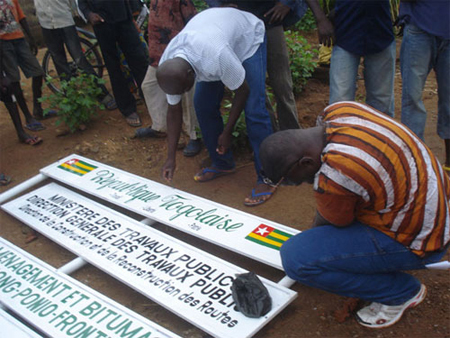
The work on the Dapaong-Ponio-Frontière axis of Burkina Faso consists of the installation of the various carriageway layers, the construction of hydraulic works, sanitation and art works, as well as the development of junctions, the installation of road signs, the construction of market hangars, boreholes, water retention and a toll station at the entrance to the village of Ponio.
The road in the city of Dapaong will be over five hundred (500) meters in double carriageway of seven (7) meters wide each lined with two (2) meters sidewalks with a 1,5 metre central ground. In the countryside, it will be a single carriageway of seven (7) meters wide with two (2) docks of 1.5 meters. In the conurbation, there is a unique nine (9) metre carriageway lined with two (2) sidewalks of two (2) metres.
The structure of the roadway will consist of a lateritic gravel foundation layer with a thickness of twenty-five (25) centimetres overlaid a layer of variable thickness, from a base layer of lateritic gravel enhanced with cement to 3.5% of a oil thickness of four (4) centimetres thick.
The drainage of the roadway is ensured by reinforced concrete ducts in agglomeration, ground ditches in a raise countryside and approaches to large structures, dalots of equilibrium between ditches in places. The crossing of the watercourses will be carried out by dalots in respect of the small watercourses, bridges for this important watercourses in Tangbamonte, Nadougou, Tamboaga and Ponio where bridges will be built from 60 to 100 metres long.
Source: DGTP/Togo
Commentaires (0)
Laisser un commentaire
Vous devez être connecté pour commenter
Articles récents
A Field Mission of the Governor of the Estuary on Compensation for Affected Populations
Lire l'article →